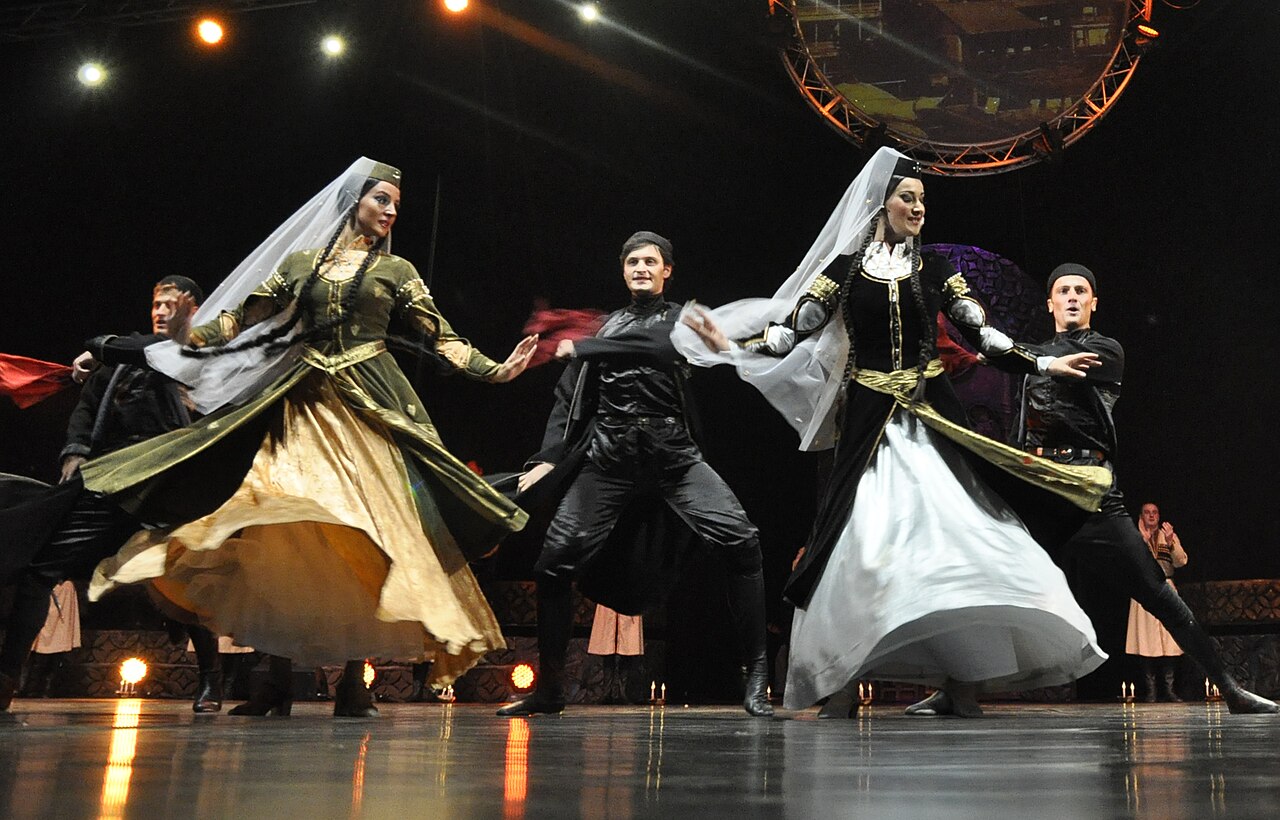
The Sukhishvili Ballet is a hallmark of Georgia and one of the most recognizable dance companies in the world; the press often refers to it as the eighth wonder of the world for its vibrancy and incredible energy.
Over its more than 80-year history, the company has toured nearly 100 countries and performed over 11,000 concerts. The Georgian Sukhishvili Ballet has performed on the stages of Broadway and La Scala, where it received 14 encores, setting a world record and earning a place of honor in the Guinness Book of World Records. Over the years, they have been admired by the Queen of England, Winston Churchill, and Franklin Roosevelt. Today, the troupe continues to tour, giving concerts in various European countries. You can find out exactly where the next performance will take place and order tickets for it at Kontramarka.de.
The Sukhishvili Ballet: A Legend of the Georgian Stage
The Sukhishvili Ballet is Georgia’s state academic folk dance ensemble. It became the country’s first professional troupe, and many other Georgian ensembles were later modeled after it.
The official founding date of the troupe is considered to be 1945, but in reality, the ensemble came into existence much earlier; on June 11, 1945, the Sukhishvili Ballet was granted state status. Later, this date was designated as the ensemble’s founding date.
Early Years and Founders
The story of the company’s founding began with the love story of two artists—Iliko Sukhishvili and Nino Ramishvili—who decided to bring traditional Georgian folklore to the professional stage.
Iliko Sukhishvili and Nino Ramishvili: Family and Background
The future founders of the Sukhishvili Ballet met at the Tbilisi Theater, where they were both working at the time. Nino Ramishvili joined the theater after graduating from the choreography studio of the Italian choreographer Marie Perini, who had trained an entire generation of outstanding dancers. At that time, Iliko Sukhishvili was already working at the theater as a choreographer and director, and he also danced in some of the ballet productions himself.
From a young age, Sukhishvili had harbored a dream of creating a dance ensemble that would bring all styles of Georgian folk choreography to life on the professional stage. And when a romance blossomed between Iliko and Nino, they combined their passion into a shared dream, forming a unique partnership that ultimately gave the world the legendary Georgian National Ballet.
The relationship between the artists began when Nino was 20 and Iliko was 21. At first, the couple lived in the Ramishvili family home—with her mother, sister, and brother. The ballerina’s father spent nearly his entire life in exile for “failing to prevent the spread of anti-Soviet literature,” but he blessed the couple in a letter from exile. Incidentally, the fact that Nino was the “daughter of an enemy of the people” would later have a significant impact on her dancing career—there would be denunciations and denials of visas for her to travel abroad on tour with the troupe. And in 1937, the young woman even had to leave her beloved Opera and Ballet Theater: one of the leading ballerinas accused Nino of trying to poison her. Sukhishvili also left the theater to follow his beloved.
1945 and the Founding of the Ensemble in Tbilisi
Although 1945 is considered the official founding date of the Sukhishvili Ballet, according to one account, the choreographer received permission from Stalin to form the troupe as early as 1937. It is said that to convince the leadership, Iliko even had to dance right in the office of the Party’s Central Committee, passing off his original choreographies as an ancient Georgian folk dance. The Sukhishvili Ballet gave its first performance as a state ensemble on June 11, 1945. At that time, the troupe consisted of only 35 people.
Education and Early Career
Before achieving worldwide fame, the artists had to undergo rigorous training. The dancers’ academic training became the foundation upon which the founders built their choreographic system.
Tbilisi Choreographic School
The Tbilisi Choreographic School became the main “training ground” for the ensemble’s members. Iliko himself studied there from 1922 to 1924, and Nino from 1922 to 1927. The school’s greatest strength for future members of the ensemble was its combination of classical ballet technique and the expressive movement characteristic of Georgian folk dance.
The dancers’ training was rigorous: endless stretching, practicing complex jumps, and, most importantly, strict discipline for everyone without any exceptions. But it was precisely this rigorous training that shaped the ensemble’s unique style and virtuosity, in which the women’s restrained grace and the men’s expressiveness blended harmoniously.
First Concert and First Tour
After a successful debut in July 1945 in Tbilisi, the ensemble set out to conquer other cities. Starting in 1948, they began touring cities across the USSR. The ensemble performed on the main stages of Moscow, Leningrad, and other major cities.
That same year, they also embarked on their first international tour to Europe. This was followed by performances in Australia and the United States, after which the ensemble gained worldwide recognition and cemented its reputation as the best for decades to come.
Breakthrough and Global Recognition
The company achieved true fame in the 1960s, when the ballet began performing regularly outside the USSR on the world’s largest stages.
Iconic productions: “Kartuli,” “Khorumi,” “Acharuli”
The ensemble’s repertoire is built on the golden treasures of Georgian choreography. Here are just a few of the productions that brought the company recognition.
“Kartuli” is an ancient Georgian wedding dance that contemporaries describe as a choreographic poem about love. It was this piece that brought Ramishvili and Sukhishvili worldwide fame. What makes this dance unique is that, although it is a partner dance intended to convey a man’s feelings for a woman, the partners maintain a certain distance throughout the entire performance without touching each other, symbolizing the purity of their relationship.
The troupe’s repertoire also includes ancient war dances, such as the Adjarian “Khorumi.” The production showcases the bravery and skill of Georgian warriors. The Sukhishvili Ballet has faithfully recreated this traditional dance. Only men appear on stage, and the plot is divided into four parts, each depicting traditional activities of a military unit (searching for a campsite, covert reconnaissance, battle, and victory celebrations).
“Archuli” has a completely different mood—it is a cheerful, spirited dance performed in colorful national costumes. This production has become one of the troupe’s signature pieces and has earned a place in the golden fund of Georgian choreography.
Tours in Europe and the U.S.
After its first tour of the USSR, the ensemble visited Poland, Romania, Czechoslovakia, Finland, France, and the United States. With each passing year, the scope of their concerts continued to expand.
One of the most iconic concerts by the Sukhishvili Ballet was its performance at Milan’s La Scala in 1967. The event was landmark for several reasons. First, it was the first folk dance ensemble to perform on the stage of the famous theater. Second, on that day, the curtain at La Scala rose a record number of times—14. That was exactly how many times the audience called the troupe back for an encore. Prior to that, the record for curtain calls was held by Enrico Caruso, who returned to the stage 11 times. At the time, the international press wrote: “Georgian ballet dancers—pure perfection!”
The company’s first performances in France generated no less excitement. Before a concert in Paris, the line to the venue stretched for three city blocks, and the ballet set yet another record: it sold out 35 consecutive performances at the same venue. A large number of famous people attended the company’s performances in France: from choreographer Serge Lifar to actors Jean Marais, Yves Montand, Gérard Philipe, and many others. Later, Iliko Sukhishvili admitted that he had never seen anything like it in his life.
Incidentally, “Sukhishvili” influenced not only the world of music but also the fashion trends of the time. Designers—including the young Yves Saint Laurent—inspired by the vibrant national costumes of the Georgian dancers, introduced a fashion trend in Europe featuring high boots, fur hats, and wide striped sashes with large bows.
The troupe was applauded at the Albert Hall in London, the Metropolitan Opera in New York, and Madison Square Garden. After their American tour, The New York Times and the Daily Mail called the performers “a whirlwind on stage” and “the flying Georgians.” And in 1990, the ballet was named the best show of the year on Broadway. The troupe received the same honor in 2001, repeating its phenomenal success during another tour.
Today, their world tours continue. You can always find the latest schedules and tickets for performances in Germany and other European countries on our website.
Style and Genre
The Sukhishvili Ballet, now as it has throughout its history, works within the genre of Georgian folk dance, but presents it at an academic level. The company has systematized and adapted unique Georgian folklore for the stage.
Georgian Folk Dance and Music
The ensemble has its own distinctive technique that captivates audiences, leaving them breathless as they watch the action unfold on stage:
the dancers move on their toes in soft leather boots, without the pointe shoes characteristic of ballet;
the performances feature lightning-fast drops to the knees;
elements of dagger dance, jigitovka, and stage fencing are incorporated, with real sparks flying from the sabers’ strikes.
A striking contrast is always evident in the performances: masculine expression and strength are set against feminine grace, as the female dancers literally glide across the stage. Another distinctive feature of the ballet is that all performances are accompanied by live music from an orchestra playing traditional Georgian instruments—the dol, panduri, chonguri, and zurna. The performers’ costumes also faithfully replicate traditional folk attire—they are made from natural fabrics and adorned with gemstones and distinctive embroidery using metallic threads.
The Most Famous Productions
Each piece from the ensemble’s repertoire is a small performance with its own storyline. But among them are some that stir the hearts of even those who are indifferent to folk dances.
“Samaya,” “Mtiuluri,” “Lezginka”
One of the most famous performances is “Samaya.” It is a majestic dance performed by three women, symbolizing youth, motherhood, and wisdom. It was inspired by ancient frescoes depicting Queen Tamara. This piece is considered one of the most graceful in the ballet’s repertoire.
“Mtiuluri” carries a completely different energy—a competitive dance of the highlanders, featuring many jumps and acrobatic moves designed to demonstrate masculine strength. When watching this production, one cannot help but admire the dancers’ power and their impeccable sense of rhythm.
“Lezginka” has also gained worldwide fame. As experts in folk dance note, Sukhishvili’s production turned out to be much more complex and vibrant than the Dagestan original, which is why audiences find it so fascinating to watch every movement of the performers on stage.
Discography and Media Projects
The troupe’s success quickly spread beyond concert halls. Over time, albums featuring their music began to appear, their performances were broadcast on TV, and later, compilations such as “Sukhishvili Ballet: The Best” were released.
Recordings on “Melodiya” and Television Performances
One of the first to recognize the ensemble’s popularity was “Melodiya,” the largest music label in the USSR. From 1960 to 1980, it released records featuring music from the Sukhishvili Ballet’s productions.
Documentary films and television programs have been made about the troupe at various times and continue to be produced; recordings of their best performances were regularly shown on Soviet central television and are now broadcast on specialized television channels. Most of the archival recordings have been digitized and, along with modern footage, are available for viewing online.
Personal Life and Legacy
The Sukhishvili Ballet, founded by a young couple of artists in love, eventually became a family business. Members of the same family have led the legendary troupe since its inception.
The Ensemble Today: Leadership and Repertoire
Iliko Sukhishvili and Nino Rimishvili remained the company’s artistic directors for 40 years—until 1985. After the father’s death, the couple’s son, Tengiz Sukhishvili, and his wife, Inga—who had also been part of the ensemble from the start—took on this role. In the early 2000s, leadership passed to the founders’ grandchildren—who share the same names as their famous grandparents—Iliko and Nino Sukhishvili.
Today, the Sukhishvili Ballet comprises more than 500 people, including dancers, musicians, management, and technical staff. Among them are more than 100 dancers.
Many are convinced that it is precisely because leadership of the company has been passed down strictly within the family that the ensemble has managed to achieve the nearly impossible: preserving the absolute authenticity and geometry of Georgian dance as established by the founders. At the same time, each generation of leaders carefully modernizes the sound quality and stage production, ensuring that ancient Georgian choreography remains in demand around the world even in the 21st century. This success opens the door to large-scale collaborative projects in which the Sukhishvili Ballet and contemporary French, German, and Ukrainian artists in Europe perform on the same stage, blurring cultural boundaries.
Interesting Facts
The Sukhishvili Ballet’s collection includes more than 2,500 stage costumes, some of which are housed in the ensemble’s own museum.
After the company’s performance in the United Kingdom, an impressed Queen Elizabeth II personally presented Iliko Sukhishvili with a gold medal.
In 1986, during a performance in India, the open-air stage collapsed and began to fall apart. To prevent the concert from being canceled and to ensure the performers were not injured, several dozen men from the audience literally supported the stage floor on their shoulders until the end of the performance.