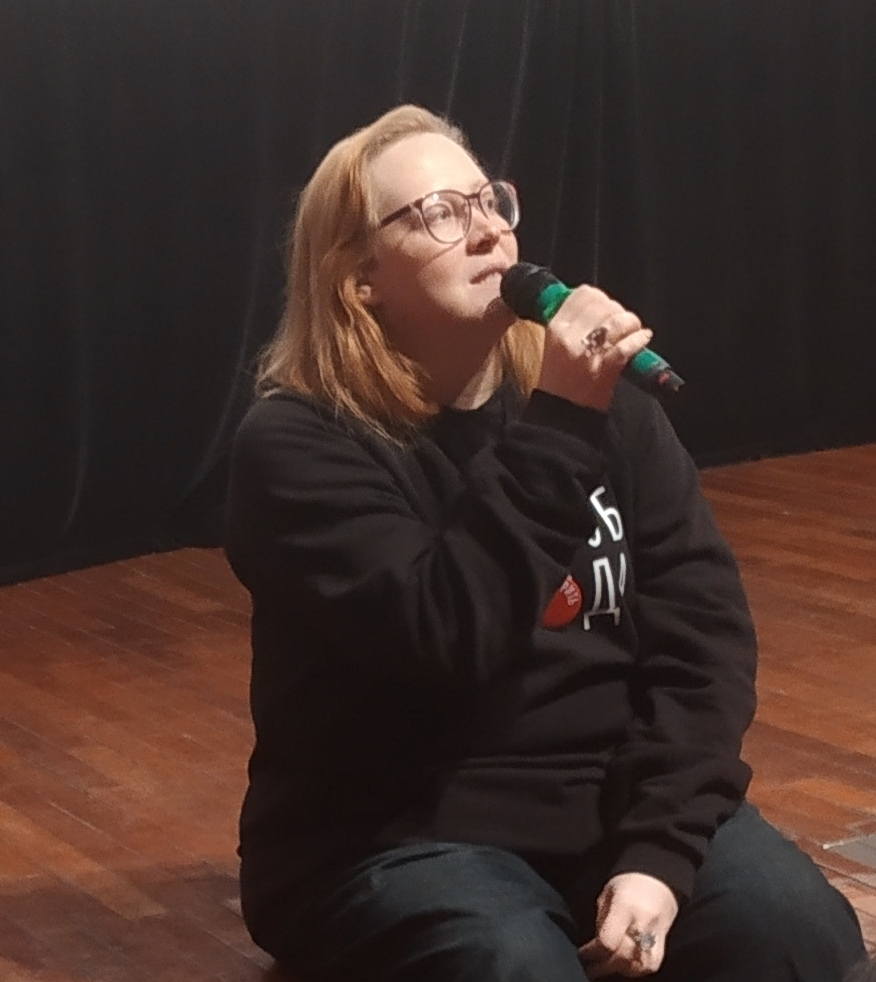
Yulia Aug is an actress, theater and film director, screenwriter, and music video director. Her creative career has spanned various phases, including the St. Petersburg Youth Theater (TYUZ), the Gogol Center in Moscow, the Estonian documentary scene, and independent film. She gained fame through the films *Ovsyanki*, *Intimate Places*, and *The Student*, as well as her role as Empress Elizabeth Petrovna in the TV series *Catherine*. Yulia Aug currently lives and works primarily in Estonia, where she directs plays, continues to act in international projects, and tours Germany and other countries around the world.
Yulia Aug: Soviet and Russian actress, director, and screenwriter
Yulia Aug was born on June 8, 1970, in Leningrad. Her career began in the late 1980s, and over the years she has evolved from a Soviet theater actress into a recognizable star of Russian cinema. At the same time, Yulia Aug does not limit herself to just one field. Today she acts in film and theater, writes screenplays, directs music videos, stages plays, and works on film sets as a director. And as the actress herself said in an interview, for her, all of this is “not so much a profession as a way of life and a way of thinking.”
Early Years and Background
Yulia Aug’s biography is closely tied to Estonia, Leningrad, and the historical tragedies of the 20th century. All of this has shaped the artist’s worldview and fostered her interest in documentary theater and productions addressing pressing social and historical issues.
Family Background and Childhood
The future actress’s parents, Arthur and Evgenia Aug, were engineers. The girl was born in Russia but spent her childhood in Estonia, in Narva, the hometown of her paternal grandfather. In addition to ethnic Estonians, Yulia’s ancestry also includes Russian, German, Jewish, and Scandinavian roots.
According to the actress, her grandmother was a hereditary aristocrat who descended from the Klettenbergs, a family of minor Swedish nobility. She taught the girl how to curtsy, embroider, and sew, and instilled in her a love of music. However, as the actress recalls, none of this interested her much as a child—she preferred the company of boys, was a “tomboy,” and didn’t even dream of the stage. Back then, Yulia was drawn to something else—archaeology. During her school years, she even took part in excavations near Narva Castle. But everything changed in 1986, after a trip to Leningrad.
The Development of an Interest in Theater and Film
In 1986, Yulia Aug traveled to Leningrad to support a friend who was applying to the theater institute. The mesmerizing atmosphere of the university made such an impression on her that she ultimately decided to dedicate her life to the stage as well. The very next year after graduating from high school in Narva, Yulia traveled to Leningrad again, but this time to apply herself to the Russian State Institute of Performing Arts (then known as LGITMiK).
Education and Professional Training
Yulia Aug did not limit herself to just one degree; instead, she systematically explored various facets of her profession by studying at different creative workshops and institutes. This thorough training ultimately allowed her to establish herself as a talented stage actress and a skilled film director.
Acting and Directing Training
Immediately after high school, Yulia enrolled at LGITMiK, joining the workshop of Soviet director and theater educator Arkady Katsman. Almost immediately, she began actively appearing in films. But balancing filming with her studies proved difficult, and in her third year, she was expelled from the university. However, this did not dampen her desire to learn. Soon after, she enrolled at GITIS (the Russian Institute of Theatre Arts) in Moscow and trained in the workshop of actor and director Mark Zakharov. Later, Aug returned to LGITMiK and subsequently graduated from the Institute of Theater, Music, and Cinematography in St. Petersburg.
In the early 2000s, having already tried her hand at theater acting and directing, Yulia Aug enrolled in the directing department of the Higher Courses for Screenwriters and Directors in Moscow, and later also earned a degree in “Theater Directing” from the Russian Academy of Theater Arts.
The Development of Creative Skills
Her well-rounded education has shaped Yulia Aug’s unique perspective on the profession. Her skills as an actress help her, as a director, to work effectively with performers, while her directorial and screenwriting vision enable her to deeply understand the structure of any play or film, precisely shaping any stage or screen role.
The Beginning of Her Theater Career
The theater became Julia Aug’s primary professional training ground. She gained her first experience with major roles and directing at the St. Petersburg Theater for Young Audiences.
Early Stage Work
Although Yulia’s first film shoots took place while she was still a student, the theater stage became a permanent part of her life in 1993, when she was accepted into the troupe of the St. Petersburg Theater for Young Audiences (TYuZ). Aug worked there for 11 years. During that time, she played eight leading roles, including Sophia in *Woe from Wit* and Lady Macbeth. A landmark performance during this period was her role in the play *Portrait* by Gogol, directed by Gennady Trostyanetsky. In this production, the actress played five roles at once.
Directing Experiences in the Theater
As a female director, Aug began her career as an assistant. In 2004, Yulia collaborated with Stanislav Govorukhin on the production *Pas de Deux*, followed by her own productions. At the same time, Aug staged the play *The Angel of Clockworks* at the Tuz Theater, based on her own play. Later, she staged productions in Dzerzhinsk, Semey, Krasnoyarsk, Moscow, Tobolsk, and Novosibirsk. And in 2013, at the “Theatrical AtomGrad” festival, Aug was named Best Director.
Breakthrough in Film
Her first on-screen role was in the film *The Abduction of the Sorcerer* (1989). But the real turning point that made her a famous Russian actress came around 2010.
Notable Film Roles
She landed her first leading film role in 2007. It was Maria Snezhnaya’s war drama *Enemies*, set in Belarus during the Nazi occupation. For this project, Aug won the award for Best Actress at the “Baltic Debuts” film festival.
The actress gained widespread fame thanks to *Ovsyanki*—a film by Alexei Fedorchenko released in 2010. Interestingly, the director found Yulia through “LiveJournal,” where she was actively posting at the time, and cast her in the role without an audition—based solely on a conversation. The film caused a sensation at the Venice Film Festival, where Quentin Tarantino himself took an interest in the actress.
This was followed by *The Heavenly Wives of the Meadow Mari*, *Intimate Places*, *The Student*, *Summer*, and *Tchaikovsky’s Wife*. And her role in the series “Catherine,” in which she played Russian Empress Elizabeth Petrovna, made her a household name throughout the CIS.
Recognition as a dramatic actress
By mid-2010, Aug had become one of the most sought-after dramatic actresses in Russian cinema. Critics noted her ability to portray tough, complex women without any outward affectation. Her talent was recognized with numerous awards, including the “Kinotavr,” “Nika,” “White Elephant,” and “TEFI” awards.
Acting Style and Roles
It is difficult to pigeonhole Aug into a single type of role. She performs with equal ease in arthouse films, historical series, contemporary dramas, and documentary-style productions.
Character and Dramatic Roles
Yulia Aug is known as a master of character roles. The actress has a knack for turning even small, cameo roles into acting masterpieces. Her greatest strength, however, lies in her dramatic range. Aug knows how to convey complex emotions without any pretense. In *The Student*, her character Inga Yuzhina is not a caricatured prude, but a woman with her own pain. Her character in *The Oats* is a heroine who exudes passion and despair. Every time she steps onto the stage or stands before the camera, Aug doesn’t simply play a role—she crafts a vivid character woven from contradictions.
Developing a Stage Character
The actress refines her stage characters in line with the director’s vision. She meticulously analyzes the motivations behind every gesture and intonation, unafraid to portray her characters as weak, sharp-tongued, or contradictory. According to Aug herself, every stage role is a way for her to experience another person’s motivations, rather than simply transforming for the sake of effect.
Most Notable Projects
Aug’s body of work includes intimate arthouse films, major TV series, and landmark stage productions.
Film Roles
The actress’s filmography consists of dozens of well-known works. Among them are:
- Tanya Kozlova in *Ovsyanki* (2020), which brought her international fame;
- Lyudmila Petrovna in the film *Intimate Places* (2013), for which the actress won the Kinotavr Award for Best Actress;
- Inga Yuzhina in *The Student* (2016), for which she won the “Nika” and “White Elephant” awards for Best Supporting Actress;
- Empress Elizabeth Petrovna in the series “Catherine” (2014).
In 2025, Aug received the Estonian EFTA Award for Best Actress in the third season of “The Traitor.” In 2026, the fourth season of this beloved series premiered, in which she once again played Jacqueline Leshkina.
Theater Productions
As an actress and director, Aug has collaborated with various theaters. On the stage of the Gogol Center, she appeared in *The Idiots* by Lars von Trier, *(The) Student* and *Persona* by Ingmar Bergman, and *The Thugs* by Kirill Serebrennikov. These works cemented her reputation as an actress drawn to contemporary, socially charged drama. One of Aug’s most iconic theater roles was that of the Portuguese queen Inês de Castro in the play *The Garden*. The production ran at the Stanislavsky Electrotheater in Moscow for just one season (that same year, Yulia left Russia for Estonia), but even in that short time, Aug’s portrayal became iconic and prompted critics to praise the power of her acting.
As a director, Julia Aug is known for her documentary and socially oriented productions, including “Narva—The City We Lost,” “My Estonian Grandmother,” and “Mom, Is Our Cat Jewish, Too?” Other key works by Aug as a director include “Elsa,” “The Phoenix Returns Home,” and “Truce.”
Screenwriting
For Julia Aug, the work of a screenwriter is not limited to simply writing the text. For each project, she seeks out a form that best reveals social conflicts and the fates of the characters.
Original Screenplays
In 2004, Aug wrote the play *The Angel of Clockworks* and directed it herself at the Youth Theater. She later wrote screenplays for documentary productions about Narva, an Estonian family, national identity, and war.
Screenwriting for Film
In film, Yulia Aug often serves as a co-screenwriter. One such example is the tragicomedy *Sakura Jam*, on which she collaborated with Igor Sharov and Dmitry Povolotsky.
Music Video Directing and Visual Projects
A lesser-known but important part of Aug’s creative career is music video directing. From 2012 to 2015, she directed videos for the rap group “25/17.” Her first music video, for the song “Zvezda” (2012), racked up a million views in just two days. In 2018, she directed a video for Dima Bilan and Polina for the song “P’yanaya Lyubov’.”
Aug’s music videos are distinctive and instantly recognizable. They don’t look like mere illustrations for the song. Each video resembles a short film—with its own mood, conflict, and vivid characters.
Directing in Theater and Film
Aug’s career as a director developed in parallel with her acting career. First came theater productions, then film and documentary projects.
Stage Productions
As a theater director, Yulia Aug has worked at various times in Russia, Kazakhstan, and Estonia. Her productions were staged at the Taganka Theater, the “Na Liteynom” Theater, the Tobolsk Drama Theater, the “Stary Dom” Theater in Novosibirsk, the Estonian Drama Theater, and Vaba Lava. Many of them are based on Aug’s own scripts.
Film directing
In film, Aug is best known for her short film *Sakura Jam*. Here, she remains true to her principles: the primary focus is on the person in the frame and their experiences.
Yulia Aug in the Media
In numerous interviews and on social media, Julia Aug often speaks about theater, film, memory, and civic responsibility.
Public Appearances and Interviews
The actress’s interviews and public statements are often quoted. She speaks candidly, without trying to please her audience. This makes her an interesting interviewee for magazines, online publications, and analytical programs.
Press Coverage of Her Work
Critics follow her new projects closely. Reviews of her stage performances and film roles appear regularly in the press. Press coverage of Yulia Aug’s work is rarely neutral: some write about her as a great dramatic actress, while others portray her as a controversial figure. But even critical articles acknowledge her high level of professionalism.
Personal Life
Julia Aug does not flaunt her personal life, but she does not hide it from the public either. In interviews, she talks about her loved ones, her roots, and her history.
Family and Loved Ones
For Yulia Aug, family has always been a source of inner strength. Her first husband was actor Stepan Zolotukhin. Their daughter, Polina, was born in 1995 and has also become an actress. Yulia’s second husband, businessman Andrei Skulov, died in December 2015 of a heart attack, which was a devastating blow to her.
Balancing Theater and Film
As she built her creative career, Yulia Aug constantly sought a balance between theater, film, and her personal life. As she later admitted, it wasn’t easy. Only the support of her loved ones helped her through it. Today, her work is primarily based in Estonia, where, as before, she finds a place for both theater and film.
Creative Principles and Perspectives
Yulia Aug’s creative principles were shaped by her theater training, film experience, and work as a director. At their core lies one fundamental rule: to be honest with herself and with the audience.
Attitude Toward the Acting Profession
According to Aug, an actor must be a holistic instrument—body, voice, psyche, and temperament must work in harmony. She has mastered this craft, which is why she is not afraid of challenging roles. At the same time, she refers to the actor as a co-creator of a play or film, someone who brings personal experience, pain, and emotions to the role.
Approach to Directing and Screenplays
Yulia Aug considers the most important aspect of directing to be the ability to create a trusting atmosphere on set, where every participant in the process feels valued and free to experiment. In her work as a director, Aug prefers to work with material that can be verified through archives, documents, letters, and testimonies. Her productions often stem from personal and family stories, but they are not limited to autobiography; they retain their social significance.
Recognition from Audiences and Critics
Aug’s recognition did not come overnight. She was first noticed by critics and audiences at film festivals, then by television viewers and international juries. Theater critics praise her ability to work with space and form, and her numerous awards confirm her status as one of the finest film actresses.
Julia Aug Today
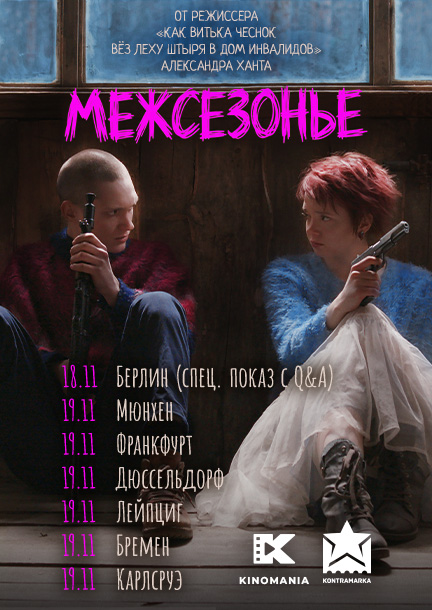
Today, Aug works primarily as an Estonian director and international actress. She directs plays in Narva and Tallinn, writes scripts, and participates in European film and television projects; she continues to appear in TV series and takes the stage as a theater actress. Fans of her work keep an eye on the performance and concert schedules in Germany so as not to miss an event featuring Aug. After all, the actress and director has new theater productions, film projects, and screenwriting on the horizon.
Interesting Facts
Professional Versatility
Yulia Aug is unique in that she masterfully combines the roles of actress, theater director, film director, and music video director. She is a recognized master in each of these fields.
Working on Both Sides of the Camera
She is equally at home both in front of the camera and in the director’s chair. This experience makes her unique: she exists simultaneously as both an actress and a director.
Check the listings on kontramarka.de so you don’t miss events where you can see Julia Aug live on stage and enjoy her talent as both an actress and a director.