Loading in progress.
Please hold on.

A screening of the movie

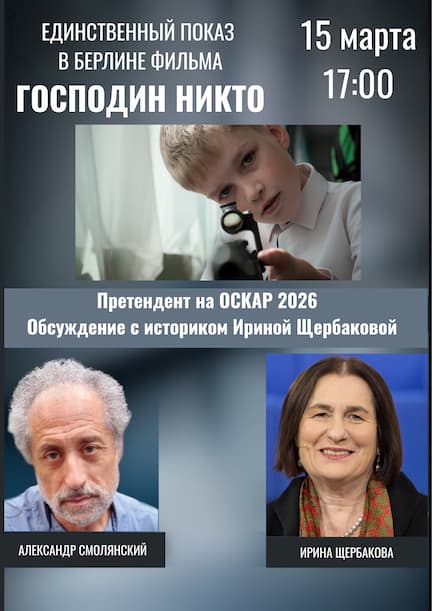
A screening of the movie "Mr. Nobody" in Berlin

A few hours before the start of the Oscar ceremony in Berlin will be a screening of the documentary "Mr. Nobody". The film was nominated for an Oscar 2026, won the BAFTA award of the British Academy and won at the Sundance Festival (USA) . After the film, Alexander Smolyansky will discuss it with Irina Shcherbakova, a historian and co-founder of the Memorial Society. It will be a conversation about time, memory and ourselves.
Information

Duration: 90 min

In Russian with German subtitles

Locations

March 2026 (1 event)
Mon Tue Wed Thu Fri Sat Sun
           
1
2
3
4
5
6
7
8
9
10
11
12
13
14
15 17:00
16
17
18
19
20
21
22
23
24
25
26
27
28
29
30
31
         
A screening of the movie "Mr. Nobody" in Berlin
15.03.2026 15.03.2026
15
Mar 2026
Sun, 17:00
Berlin
Jüdische Gemeinde

Event description

The only Berlin screening of the documentary film, which in Russia is called "Mr. Nobody", but around the world it is known as "Mr. Nobody Against Putin". The film was nominated for an Oscar 2026, won the Bafta Award, received the Special Jury Prize at the main independent film festival Sundance (USA) and won at 17 other international film festivals.

The main character and co-director of the film, schoolteacher Pavel Talankin, has documented the frightening transformation of Russian schools. The viewer sees how schools are turning into a platform for ideological processing and planting a new picture of the world. This is not just a documentary chronicle, but an in-depth study of the ethical impasse in which an ordinary person finds himself, forced to exist inside the propaganda machine. After the screening, Alexander Smolyansky will discuss the movie with Irina Shcherbakova, a historian, researcher of totalitarianism, and co-founder of the Memorial Society.

Here are just some of the questions that will be discussed:

  • How do the propaganda mechanisms shown in the movie correlate historically with the experience of the totalitarian regimes of the last century?
  • Why do schools and children always become the first and foremost target for ideological processing?
  • Why do people so easily accept the absurd as the norm?
  • Where is the line between conformity for survival and complicity in crime?
  • What happens to historical memory when the state completely monopolizes the right to interpret the past?
  • How do the substitution of concepts and the distortion of language change thinking and shape the "new man"?
  • What does this movie show: the local tragedy of one society or the global vulnerability of human nature to propaganda?
  • How will the generation, whose school years were spent in conditions of total ideological processing, grow up, and is there a chance for its "recovery"?
  • How to preserve inner freedom, human dignity and common sense under the pressure of dictatorship?
  • What foundation for the future is being laid right now, and is there room for historical truth in that future?

This will be a conversation about time, memory and ourselves.

Event feedback

I have read and agree to the Terms of Service (AGB) and Privacy Policy (Privacy Policy).