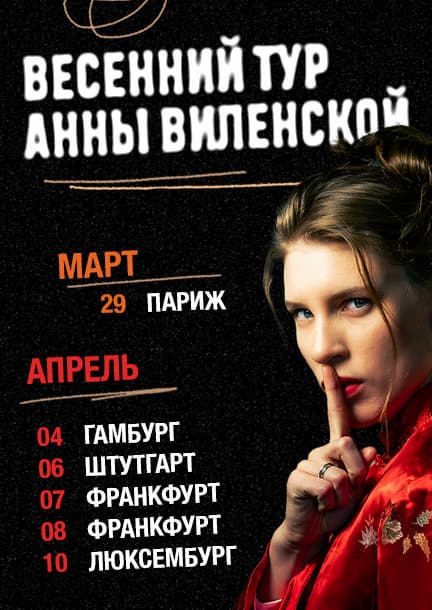
Anna Vilenskaya is a musicologist, lecturer and popularizer of classical and contemporary music. She is able to talk about complex things simply, entertainingly and with humor, helping listeners to hear music in a new way and understand how it works.
The topic of the lecture: Hit or Hype? Anna Vilenskaya and Natasha Panfilova
Debates between musician and marketer about the power of algorithms over the culture of taste and where hits are born: in the studio or in the marketing department.
Intellectual battle and performance in Paris with the audience, who with the help of real-time voting will decide whether the talent of the artist or the engineering of attention from his team is behind the hits of the 21st century?
What's in store for you
- A breakdown of the hits that the whole world knows
- Explanation of why these particular songs "shot up"
- musical experiments and mini-performances
- marketing tricks that make the track viral
- interactive: the audience votes on who is more convincing
- light atmosphere, humor and lively communication
Theme of the lecture: Bach: great, but by what?
It seems it's time to talk about Bach. Musical history textbooks begin with him. He was listened to and respected by his contemporaries, classical, romantic and modernist alike. But what did Bach do that was so special? Let's talk about how he combined lines into polyphonic fabric, how he arranged musical actionism, and how his approach differed from his contemporaries. Basically, let's try to understand why Bach is so special. No prior knowledge of any music is necessary.
Lecture topic: How electronic music smoothly changed people's ears
In this lecture we will talk about how people invented electronic instruments and how this changed people's attitude towards timbre and rhythm. We will talk about specific music, the first drum machine, rap, computer games, the Beatles' "White Album," Steve Reich, The Prodigy, and Radiohead favorites. No prior knowledge of any music is necessary.
Lecture topic: Pink Floyd and psychedelic rock: what was it?
Pink Floyd are some of the most unusual rockers of the 20th century. Their songs stretch for 17 minutes, if not more. Their music is commonly referred to as "psychedelic" rock, but if you put aside the cultural peculiarities of the time, it's not very clear how else to describe the unusual style of rock music that Pink Floyd practiced. Let's try to do it! In the lecture we will get to know Pink Floyd songs to like them and the history of the band to understand them. No prior knowledge of any music is necessary.
Lecture topic: Background Music
"Background music" is a very new concept. Only the 20th century could afford it, and at first composers had very different ideas about how to compose it. Let's talk about how our brains perceive background music, how Brian Eno prilumal soothes passengers in aerophobia with ambient, who wrote music for elevators, and how they compose melodies that sound on hold on telephone lines. After all, it's background music that holds the imprint of an era, like Frutiger or retrowave music. Let's take background music seriously and find the beauty in it. No prior knowledge of any music is necessary.
Lecture topic: Musical Hearing: Instruction Manual
It is not uncommon to hear the phrase: "I have no musical hearing", "a bear stepped on my ear". Maybe you even once uttered it yourself. In reality, this is not the case: all hearing people develop a complex set of several components of musical hearing in the first years of life. If you think that everyone has it, but you don't - come to the lecture and let's experiment together on your sense of fret and relative hearing.
We will check whether you have musical synesthesia - a phenomenon in which sounds turn into colors, and find out whether we see chords in the same colors. After the lecture, you will leave with an understanding of how to train your musical ear, how to use it properly, and most importantly, with the feeling that no bear has stepped on your ear.
More details
Hide